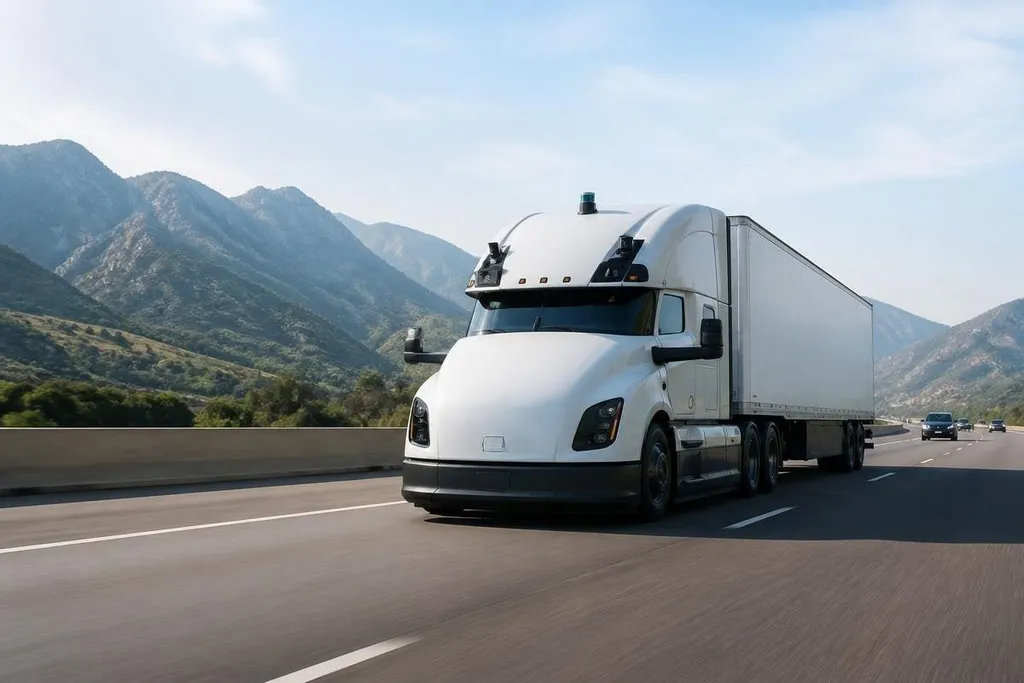
A truck that drives itself on a highway still needs people at the depot, at the loading dock, and during unusual events. That makes self-driving trucks a practical automation question, not a simple replacement for a driver.
- Highway driving is the easiest part to automate
- Freight routes may need remote help and depot staff
- Weather, roadwork, and loading work remain hard problems
The work starts with repeatable routes
Long-haul freight often follows known roads for long periods. Trucks can use cameras, radar, GPS, and onboard computers to track lane markings, nearby vehicles, speed limits, and road position.
That repeatable setting gives developers a narrower job than fully autonomous driving in a city. A truck may spend hours on a divided highway, then hand control to a person before it reaches a busy street or a customer site.
The handoff matters because the truck's job changes at the edge of the highway. A depot may have tight turns, people walking between trailers, damaged pavement, temporary cones, and loading rules that the vehicle can't read from a map alone.
Highway miles also expose a cost question. A truck that needs a safety operator watching every second may reduce the value of automation. The system has to handle routine driving for long periods while giving a person enough warning and information to manage a rare problem.
Why freight operators are paying attention
A self-driving truck could let a freight company divide a trip into two parts. The automated system could handle a mapped highway section, while a driver or trained worker manages the parts that need local judgment.
That model may change where people work rather than remove people from the whole job. Staff could move a trailer into position, check the load, guide the truck through a yard, or take control when a route leaves the approved operating area.
The economic case depends on the full operation. A company has to count the truck, sensors, software, remote support, maintenance, insurance, depot changes, and time lost when the system stops. A lower wage bill alone doesn't show whether the plan works.
Fuel use also depends on the route and the driving system. Smooth speed changes can reduce wasted motion, but a truck that stops often for uncertain conditions may lose that benefit. The result needs measurement over real routes, not a short road test.
Fleet managers need dated facts about the truck, route, weather, safety driver, and remote support before a road demo can guide a purchase. Robot24.com truck robotics reporting can place those details beside the claim, giving you a record to check before the hard parts outside the demo begin.
The hard parts are outside the demo
A clear highway is a friendly test. Real freight brings rain on a dirty camera, glare near sunset, worn lane lines, loose cargo, roadwork, emergency vehicles, and drivers who behave in ways a planned route can't predict.
A truck also has to fail in a controlled way. It may need to slow down, pull over, stop in a safe place, or ask for remote help. Each response takes time, road space, and a working connection to a support team.
Remote support doesn't mean a person drives every mile from a desk. It can mean a trained operator reviews the scene, chooses from approved actions, or tells the truck which safe route to take. The exact division of work matters because it sets staffing needs.
The public evidence for many systems still leaves open questions about long-term operation. A short video can show lane keeping and a clean handoff, but it can't show how often the truck stops, how staff respond at 2 a.m., or what repairs cost after months of service.
Check the plan before buying into it
Use this checklist when you assess a self-driving truck project:
- Map the route. List every road, depot, border crossing, and delivery area the truck must handle.
- Set the handoff point. Mark where automation ends and name the person who takes control.
- Count the stops. Record each safety stop, remote request, weather pause, and map exception.
- Price the support team. Include training, shift cover, communications, and response time.
- Test the depot. Check trailer moves, pedestrians, loading bays, damaged pavement, and emergency access.
- Define the proof. Ask for route hours, intervention counts, downtime, repairs, and cargo results.
The plan is worth more attention when it improves a defined route without hiding the human work around it. I'd skip any proposal that treats highway automation as the whole trucking job.
Self-driving trucks are becoming more important because freight companies need repeatable ways to handle long routes, but the useful system will still include people. The next proof point is simple: how many loaded trips can a truck complete, on a named route, before a person must step in.